Updates

November 2025

Five members of the COMBB research team presented papers at the Coast and Estuarine Research Federation biennial meeting November 9-13 in Richmond, VA.

Rachel Jakuba presented, “The future is now: Adapting a long-term volunteer monitoring program to leverage low-cost sensors.”

Lilia Bartolotta presented, “Continuous oxygen monitoring in Buzzards Bay: The good, the bad, and the biofouling.”

Lara Gulmann presented, “Introducing buzzardsbay: An R-based tool for efficient quality control and analysis of estuarine oxygen data.”

Kristin Huizenga presented, “Historical and spatial lessons on dissolved oxygen in Buzzards Bay: Grab samples vs sensors.”

Christopher Neill presented, “Quantifying riverine nitrogen fluxes to Buzzards Bay from coastal watersheds.”

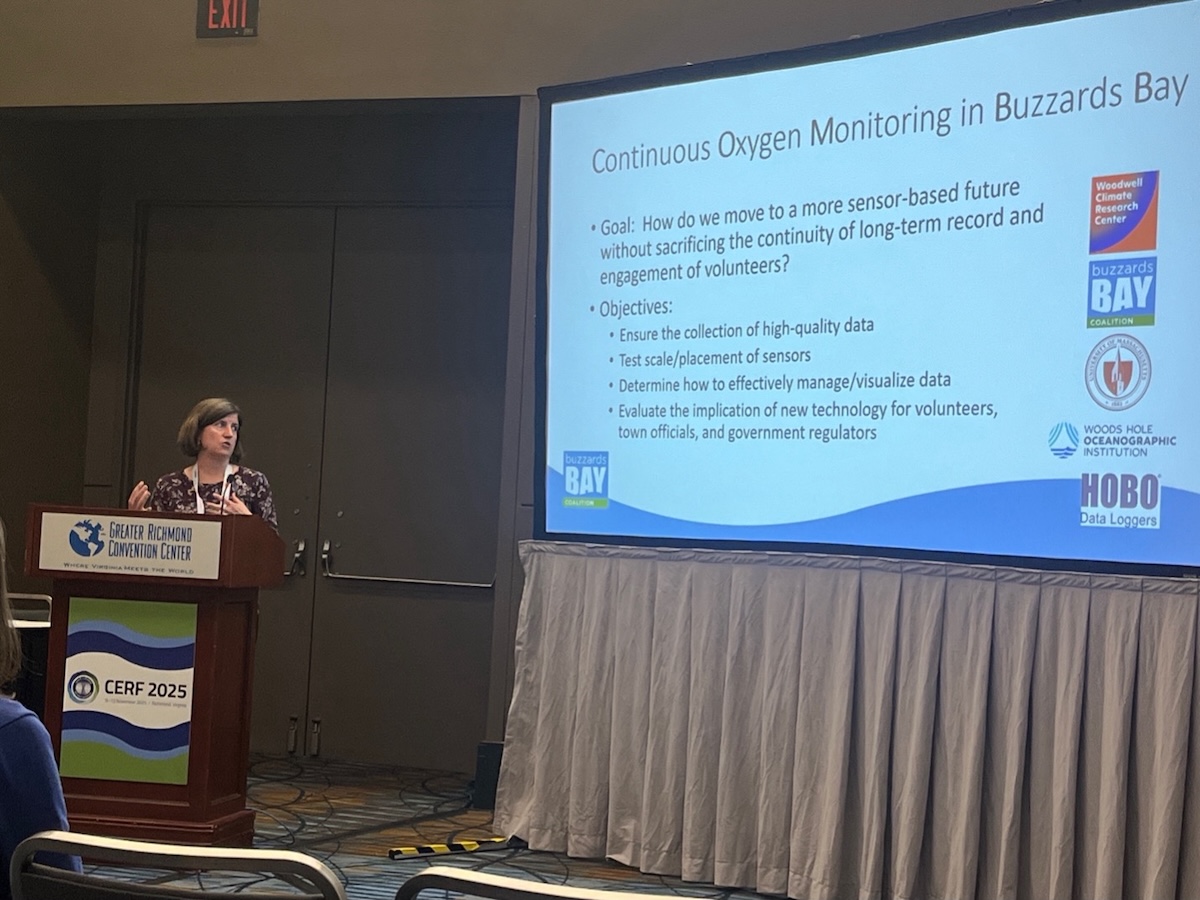
Rachel Jakuba, Vice President for Science at the Buzzards Bay Coalition, talked about transitioning from grab samples to sensors at the 2025 biennial Coast and Estuarine Research Federation meeting in Richmond, VA. Photo by Chris Neill.

October 2025

The COMBB team closed out another successful field season by retrieving the oxygen and conductivity dataloggers that were deployed since early May in West Falmouth Harbor, Onset Bay, the Acushnet River, and Apponagansett Bay.

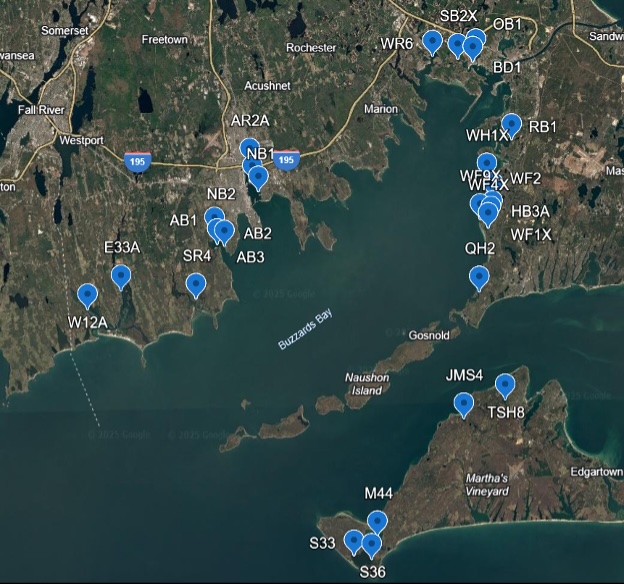
The Buzzards Bay Coalition expanded datalogger deployments to 10 additional locations around Buzzards Bay and on Martha’s Vineyard in 2025.

A map of all 26 COMBB project and Buzzards Bay Coalition dissolved oxygen and salinity datalogger deployments in summer 2025.

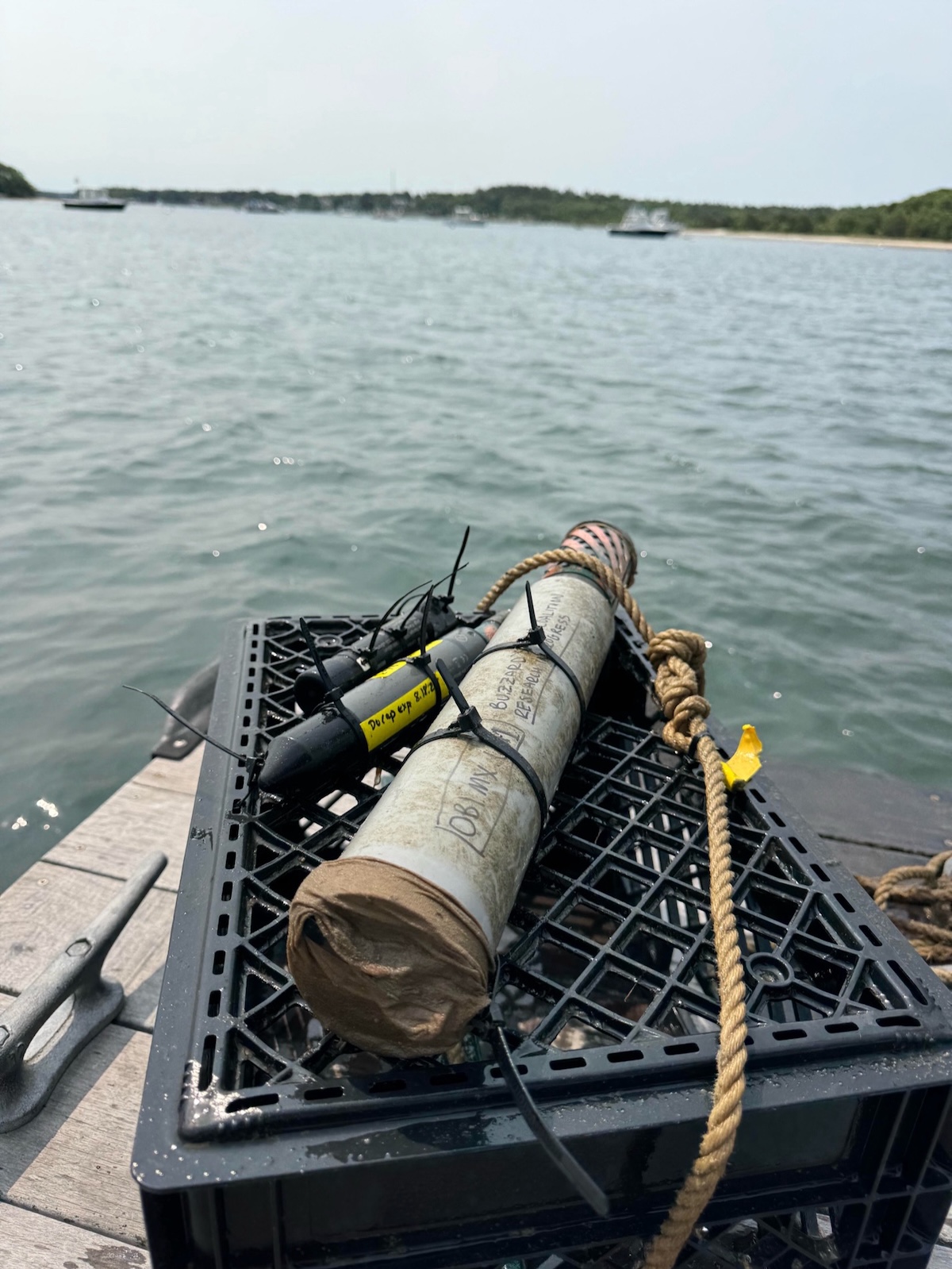
The COMBB field team retrieved HOBO oxygen and conductivity sensors deployed in Onset Bay. Sensors will be cleaned, calibrated, and stored for the winter. Photo by Kristin Huizenga.

September 2025

Four TideRiders built during 2025 field season were deployed in either West Falmouth Harbor or Onset Bay every week from mid-June to mid-August. The units were constructed and operated by local high school students Erik Gulmann and Ray Zhang. Dissolved oxygen data from deployments has been calibrated and submitted to Buzzards Bay Coalition to run through their QC pipeline, along with vehicle positioning data. The team’s ability to pilot the units steadily improved during the summer, which led to longer and longer deployments.

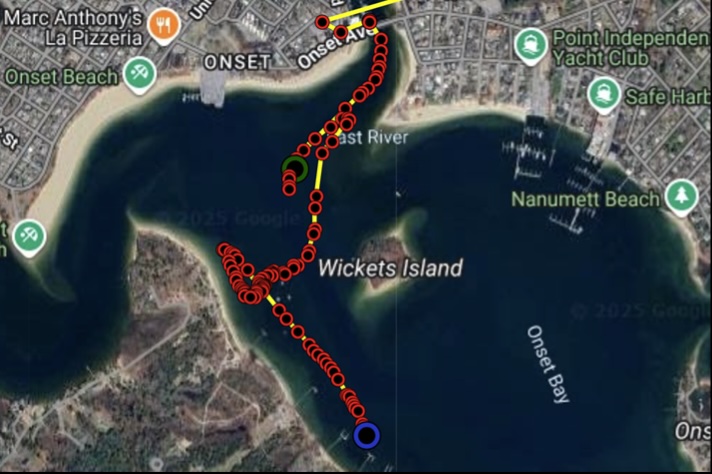
The track of a five-day TideRider deployment in Onset Bay.

September 2025

Emily Caruso led field sessions at the Onset Bay Center with Baywatchers volunteers and community members to understand how people interact with different water-quality monitoring tools. Through hands-on activities and interviews, she explored how participants with different levels of experience learned, adapted, and responded to both traditional methods and newer sensor-based technologies. This work will be part of Emily’s Ph.D. thesis with Anita Milman at the University of Massachusetts, Amherst.

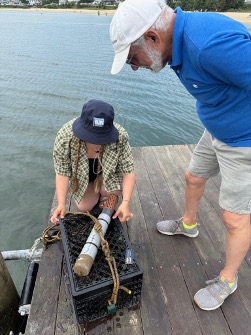
Emily Caruso explains a dissolved oxygen-measuring datalogger to one of her interviewees at Onset Bay.

August 2025

Reece Thompson and Olivia Bonevich presented talks from their summer research at the Woodwell Climate Research Center’s summer intern symposium on August 6. Reece talked about relationships between low dissolved oxygen measured by recording sensors, temperature, wind, and solar radiation. Olivia talked about options for towns to meet their total maximum daily load targets. Those targets were determined by the State of Massachusetts based on Baywatchers monitoring data.

The COMBB field team worked diligently to maintain sensors that were deployed over the summer.

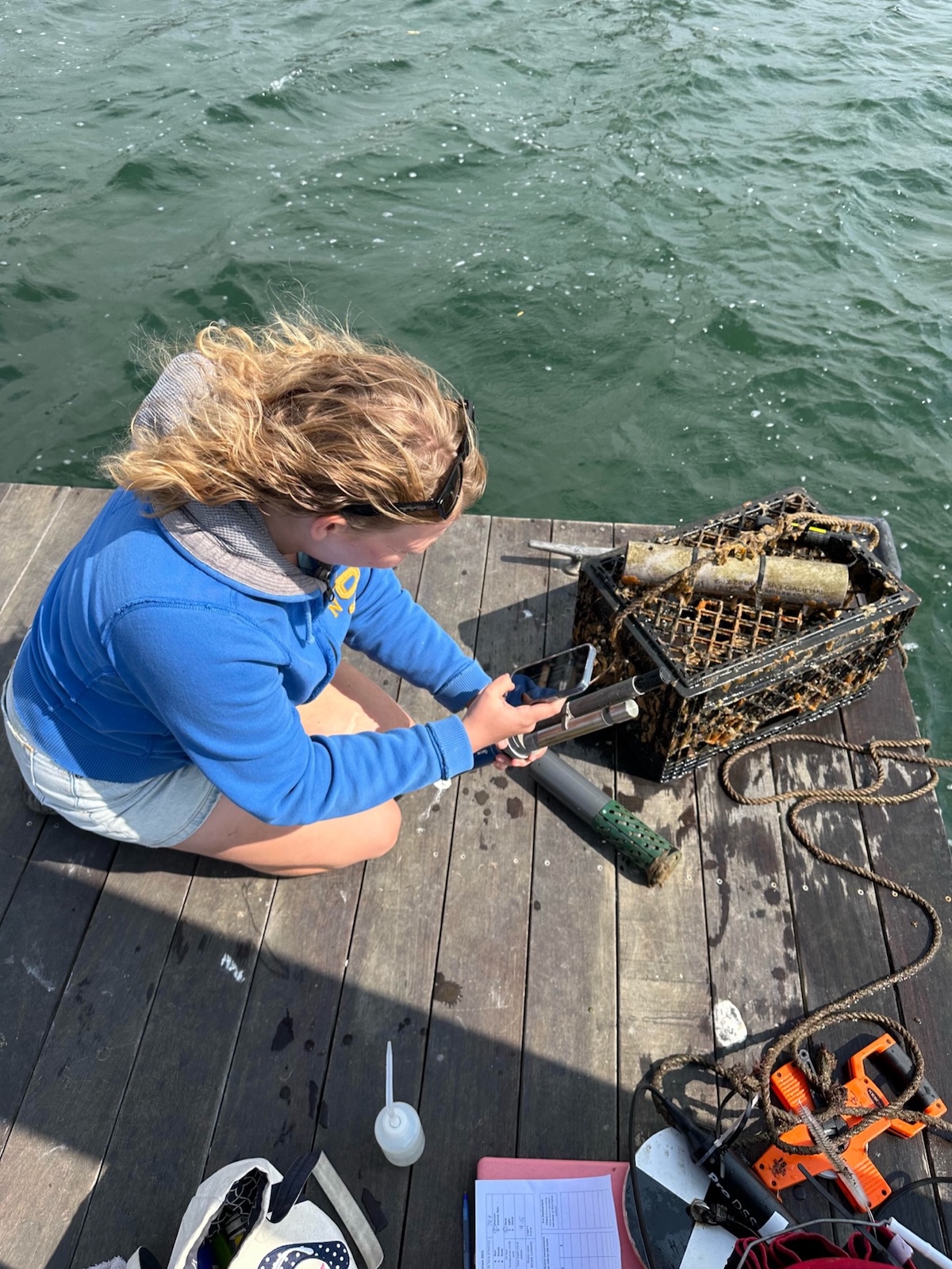
Kristin Huizenga documents fouling as part of the regular COMBB sensor maintenance protocol.

July 2025

Three members of the COMBB research team presented papers at the Society of Wetland Scientist meeting in Providence, RI on July 16 as part of a symposium entitled, Quantifying and restoring wetland ecosystem functions in coastal watersheds, organized by COMBB lead PI Chris Neill. Chris presented an overview talk, Kristen Huizenga presented on trends in the timing of low dissolved oxygen in Buzzards Bay determined from the long-term Baywatchers data, and Maya Weiss presented on river nitrogen fluxes.

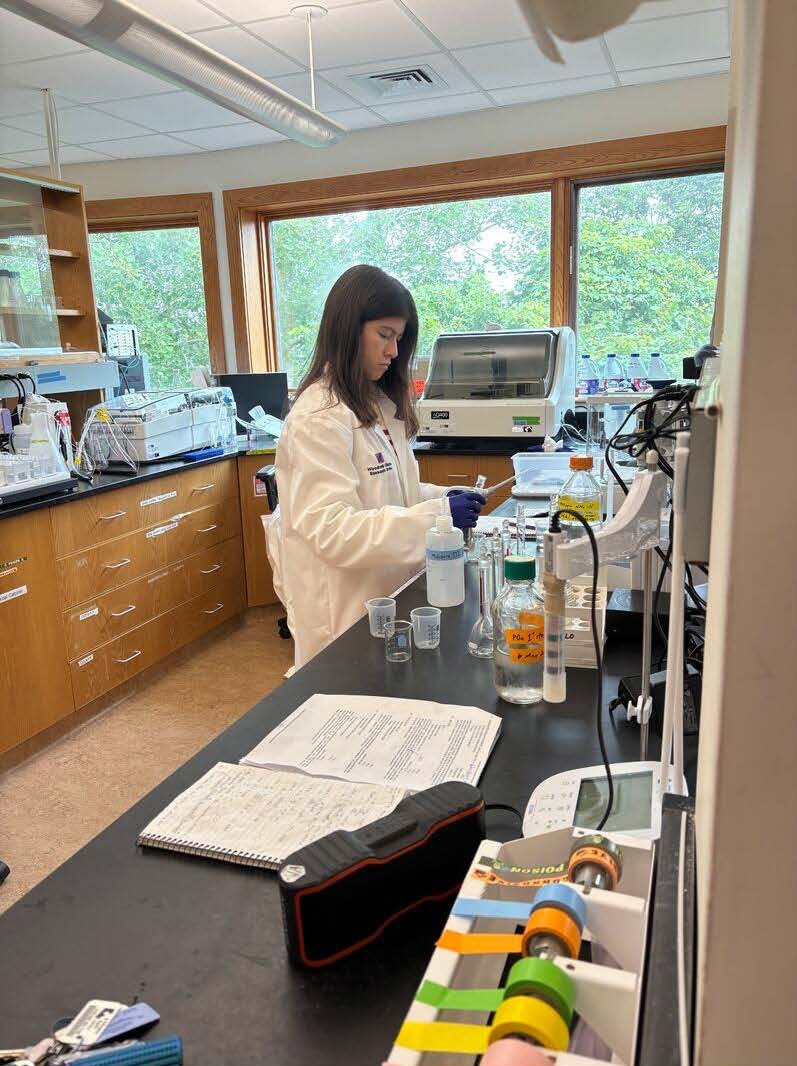
The first round of Baywatchers water samples arrived in the laboratory on July 7.

Olivia Bonevich analyzes first round of Baywatchers samples in the Woodwell laboratory.

June 2025

The Baywatchers nutrient samples will be analyzed at the Woodwell Climate Research Center starting with the first nutrient collection day on July 7. Helen Sears, a biogeochemist who trained at the University of New Hampshire, joined Woodwell and the COMBB team and will oversee the laboratory. Summer research assistant Olivia Bonevich from the University of California, Los Angeles, joined her in the laboratory and is also looking at the potential policies that towns can implement to meet their required nitrogen reduction targets.

May 2025

The COMBB team began the year’s deployments of dataloggers in Onset Bay, Apponagansett Bay, the Acushnet River, and West Falmouth Harbor. By the end of May, 15 oxygen/temperature/conductivity loggers were deployed in these four estuaries. An additional 12 loggers were deployed in estuaries from Martha’s Vineyard to Westport.

Reece Thompson, an REU from the University of Alabama, and Erin Mansfield from North Carolina State University both joined the COMBB team for the summer. They help manage the logger deployments, logger data, and ensure data quality control.

April 2025

Maya Weiss defended her distinguished majors program (DMP) undergraduate thesis at the University of Virginia. Maya’s thesis used hydrological and chemical data to calculate the fluxes of nitrate, ammonium, dissolved organic nitrogen, and particulate organic nitrogen reaching Buzzards Bay in eleven streams and rivers that have been monitored since 2022. She found that dissolved organic nitrogen, and not nitrate, dominated the annual fluxes in the largest rivers, especially rivers with large areas of cranberries in their watersheds. Maya is following up her thesis by working with the COMBB team to produce both a scientific paper and an “atlas” of Buzzards Bay rivers aimed at a general audience that will be published by the Buzzards Bay Coalition.

February 2025

The Buzzards Bay Coalition in January 2025 took over the lead role in continued measurements of the discharge and nutrient concentrations in 12 streams and rivers that discharge to Buzzards Bay. This project, begun by Chris Neill at Woodwell Climate and Casey Kennedy at the University of Massachusetts Cranberry Station in 2021, will ensure that this major source of nitrogen to Buzzards Bay in rivers continues to be monitored closely.

Chris Neill of Woodwell Climate (left), and Tony Williams (center) and Lilia Bartolatta of the BBC check on a water level sensor in the West Westport River in January 2025.